

Hey there! As a supplier of portable 4G jammers, I often get asked about the frequency bands these devices cover. So, I thought I'd write this blog to give you all the deets.
First off, let's understand what a portable 4G jammer is. It's a nifty little device that can block 4G signals in a certain area. You might be wondering why someone would want to do that. Well, there are a bunch of reasons. For example, in exam halls, jammers can prevent students from using their phones to cheat. In sensitive business meetings, they can stop people from leaking confidential information via phone signals.
Now, onto the main question: what frequency bands does a portable 4G jammer cover?

Common Frequency Bands Covered
1. LTE Bands
LTE (Long - Term Evolution) is the technology behind 4G networks. There are multiple LTE bands used around the world. A good portable 4G jammer usually covers the most commonly used LTE bands.
- Band 1 (2100 MHz): This is one of the most widely used LTE bands globally. It's used by many carriers for their 4G services. Our jammers are designed to effectively block signals in this band, making sure that any 4G connection relying on Band 1 is disrupted.
- Band 3 (1800 MHz): Another very popular LTE band. It offers good coverage and is used in many countries. When you use our portable 4G jammer, you can be confident that it will take care of Band 3 signals as well.
- Band 7 (2600 MHz): This high - frequency band is often used for high - speed data transmission. Our jammers are equipped to handle this band, ensuring that even the fastest 4G connections using Band 7 are jammed.
2. GSM Bands
Although we're talking about 4G jammers, many of them also cover GSM (Global System for Mobile Communications) bands. This is because in some areas, 4G networks might fall back to GSM when the 4G signal is weak.
- GSM 900 MHz: This is a classic GSM band that has been around for ages. It provides wide - area coverage. Our portable 4G jammers can block signals in this band, so even if the phone tries to switch to GSM 900, it won't be able to establish a connection.
- GSM 1800 MHz: Also known as DCS 1800, this band is used in many urban areas. Our jammers are capable of jamming signals in this band too, giving you comprehensive signal blocking.
3. WCDMA Bands
WCDMA (Wideband Code Division Multiple Access) is another technology used in 3G and some early 4G networks. Some portable 4G jammers also cover WCDMA bands to ensure complete signal disruption.
- WCDMA 2100 MHz: This band is often used in 3G and 4G networks. Our jammers can block the signals in this band, preventing phones from connecting to the network using WCDMA 2100.
Different Models and Their Coverage
We offer different models of portable 4G jammers, each with its own unique frequency band coverage.
- Mobile Phone Signal Jammer High Power 8 Antennas High Power Phone Signal Jammer: This model is a beast when it comes to signal blocking. It covers a wide range of frequency bands, including all the major LTE, GSM, and WCDMA bands we mentioned earlier. With 8 antennas, it can provide a strong and stable jamming signal. You can check out more details about this model here.
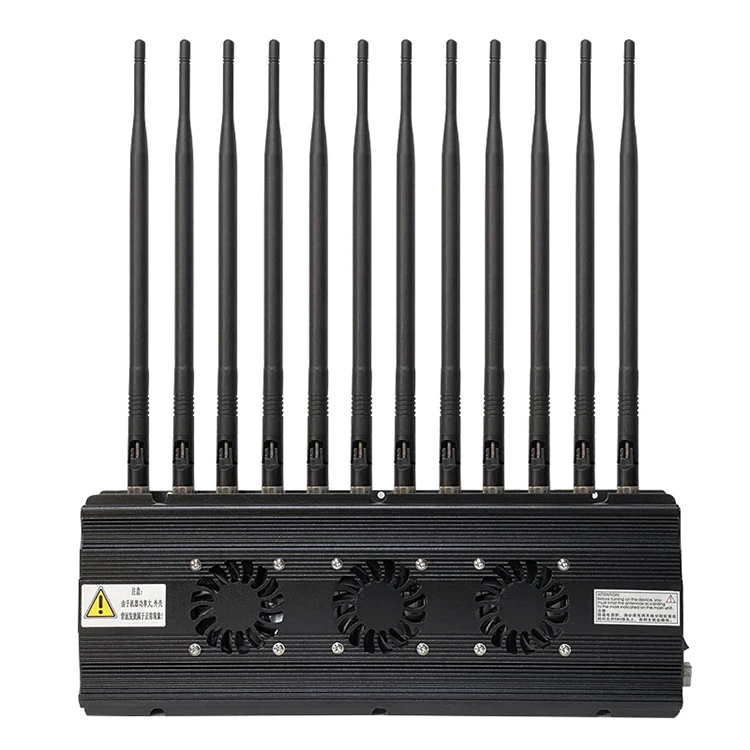
- Mobile Phone Signal Jammer High Power 12 Antennas High Power Phone Signal Jammer: If you need even more powerful signal blocking, this is the model for you. The 12 - antenna design allows it to cover an even wider area and more frequency bands. It's perfect for large - scale applications like big conference halls or large exam centers. You can find out more about this amazing model here.
Factors Affecting Frequency Band Coverage
It's important to note that the actual frequency band coverage of a portable 4G jammer can be affected by several factors.
- Power Output: The higher the power output of the jammer, the more effectively it can cover a wider range of frequency bands. Our high - power models are designed to provide maximum coverage.
- Surrounding Environment: If there are a lot of obstacles like thick walls or metal structures, it can reduce the effectiveness of the jammer. However, our jammers are designed to work well even in challenging environments.
- Distance from the Jammer: The closer the phone is to the jammer, the more likely it is that the signal will be blocked. Our jammers have a certain effective range, and within that range, they can block signals on the covered frequency bands very well.
Conclusion
So, there you have it! A portable 4G jammer typically covers a wide range of frequency bands, including major LTE, GSM, and WCDMA bands. Our different models, like the Mobile Phone Signal Jammer High Power 8 Antennas High Power Phone Signal Jammer and Mobile Phone Signal Jammer High Power 12 Antennas High Power Phone Signal Jammer, offer different levels of coverage to suit your needs.
If you're interested in purchasing a portable 4G jammer, whether it's for an exam hall, a business meeting, or any other application, feel free to reach out. We're here to help you choose the right model for your specific requirements. Let's start a conversation and find the perfect solution for you!
References
- Telecommunication standards documents related to LTE, GSM, and WCDMA technologies.
- In - house research and development reports on the performance of our portable 4G jammers.