

Hey there! As a supplier of signal jammers, I often get asked a bunch of questions about how these nifty devices work. One question that pops up quite a bit is, "Do signal jammers work in metal - enclosed spaces?" Well, let's dive right into this topic and find out.
First off, let's understand what a signal jammer does. A signal jammer is a device designed to block or interfere with the radio frequency signals that mobile phones, Wi - Fi devices, and other wireless gadgets use to communicate. It emits radio waves on the same frequencies as these signals, creating interference and effectively "jamming" the communication.
Now, metal - enclosed spaces are a whole different ballgame. Metal is a great conductor of electricity, and it has some unique properties when it comes to radio waves. One of the most well - known phenomena related to metal and radio waves is the Faraday cage effect. A Faraday cage is essentially an enclosure made of conductive material (like metal) that can block external electromagnetic fields. When a metal enclosure forms a complete or nearly complete shield around an area, it can prevent radio waves from entering or leaving.
So, does this mean that signal jammers won't work in metal - enclosed spaces? Not necessarily. It depends on a few factors.
The Strength of the Jammer
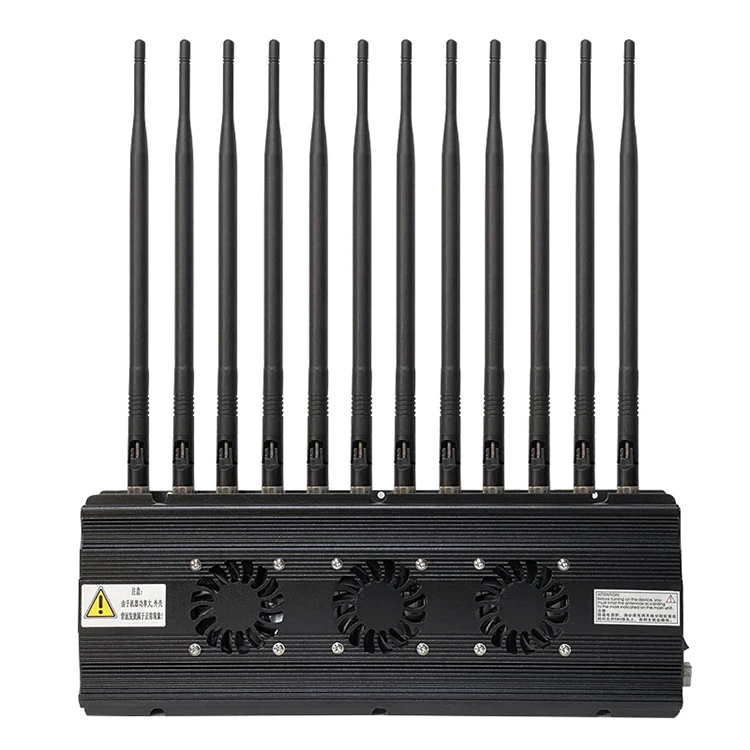
The power of the signal jammer plays a crucial role. A more powerful jammer is more likely to penetrate a metal enclosure. For example, our Mobile Phone Signal Jammer High Power 8 Antennas High Power Phone Signal Jammer and Mobile Phone Signal Jammer High Power 12 Antennas High Power Phone Signal Jammer are designed with high power and multiple antennas. The high power allows the jammer to generate stronger radio waves, and the multiple antennas can help distribute the jamming signal more effectively. If the metal enclosure isn't a perfect Faraday cage (which is often the case in real - world scenarios), these high - power jammers may be able to overcome the shielding effect of the metal to some extent.
The Quality of the Metal Enclosure
The quality and integrity of the metal enclosure matter a lot. If the metal enclosure has gaps, holes, or seams, radio waves can leak in or out. For instance, in a metal shipping container, there are usually small gaps around the doors and ventilation holes. These openings can act as weak points in the shielding, allowing the jamming signal to get inside. On the other hand, a well - constructed, air - tight metal room with no significant openings will be much more effective at blocking both external signals and the jamming signal.
The Frequency of the Signals
Different frequencies of radio waves interact with metal in different ways. Some frequencies are more easily blocked by metal than others. Mobile phones operate on various frequency bands, such as GSM, 3G, 4G, and now 5G. A good signal jammer should be able to cover a wide range of frequencies to be effective. Our high - power jammers are designed to cover multiple frequency bands, increasing the chances of jamming signals even in challenging metal - enclosed environments.
Real - World Examples
Let's take a look at some real - world situations. In a metal - framed building with metal siding, there are often enough gaps and penetrations for the jamming signal to reach the interior. Many office buildings and warehouses fall into this category. Our customers have reported that our high - power signal jammers can work quite well in these types of structures, effectively blocking mobile phone signals and Wi - Fi connections.
However, in a specialized Faraday cage - like environment, such as a military - grade electromagnetic shielding room, it will be extremely difficult for a signal jammer to work. These rooms are designed to be air - tight and highly conductive, providing maximum protection against external electromagnetic interference.

Tips for Using Signal Jammers in Metal - Enclosed Spaces
If you're planning to use a signal jammer in a metal - enclosed space, here are some tips:
- Choose the Right Jammer: As mentioned earlier, opt for a high - power jammer with multiple antennas. Our high - power models are designed to handle challenging environments.
- Check the Enclosure: Look for any gaps, holes, or seams in the metal enclosure. You can try to position the jammer near these weak points to increase the chances of the jamming signal getting inside.
- Test the Jammer: Before relying on the jammer for a critical application, test it in the specific metal - enclosed space. This will give you a better idea of its effectiveness.
In conclusion, signal jammers can work in metal - enclosed spaces, but it's not guaranteed. The strength of the jammer, the quality of the metal enclosure, and the frequency of the signals all play important roles. If you're facing a situation where you need to block signals in a metal - enclosed area, we're here to help. Our team of experts can assist you in choosing the right signal jammer for your specific needs. Whether it's for a business meeting where you want to avoid distractions, or a security - sensitive area where you need to prevent unauthorized communication, we've got you covered.
If you're interested in learning more about our signal jammers or want to discuss a potential purchase, don't hesitate to reach out. We're always happy to have a chat and help you find the best solution for your requirements.
References
- "Electromagnetic Fields and Waves" by Fawwaz T. Ulaby, Eric Michielssen, and Umberto Ravaioli.
- "Mobile Communications" by Jochen Schiller.